Laguna Cejar and the Floating Lagoons: Complete Guide
Laguna Cejar sits on the northern edge of the Salar de Atacama, about twenty kilometres from San Pedro. The water is so saturated with salt that you cannot sink in it, and that single physical fact drives the most popular half-day outing in the desert.
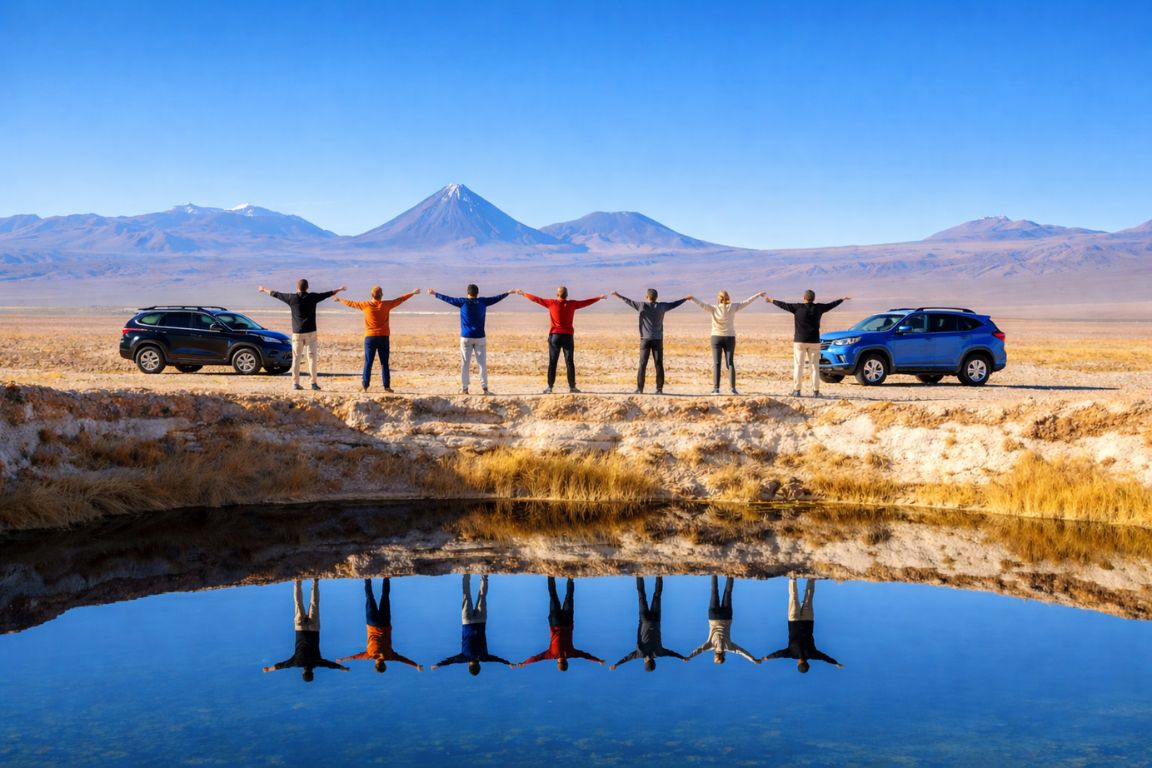
Why do you float in Laguna Cejar?
Because the water carries so much dissolved salt that it is denser than your body. Buoyancy depends on the density of the fluid you displace, and once salinity climbs high enough, the water pushes back harder than you weigh. You do not swim in Laguna Cejar. You lie on it.
The salt comes from the Salar de Atacama itself, a vast basin with no outlet to the sea. Water flows in from the Andes carrying dissolved minerals, and then it has nowhere to go except into the air. Evaporation in one of the driest places on earth removes the water and leaves everything else behind, concentrating year after year until the remaining brine is a fraction salt by weight.
People ask for a number, and the honest answer is that there is not a single stable one. Salinity in these lagoons shifts with the season, with rainfall in the high Andes and with how hard the sun has been working. What stays constant is the effect: brine at this concentration is comfortably denser than a human body, and the flotation is not subtle. It is in the same league as the Dead Sea, which is the comparison every guide reaches for and the one that best sets expectations.
That density also explains everything else about the visit: why you cannot put your face in, why cuts sting, why you must rinse, and why the crust around the shoreline crunches like frozen snow. The whole experience follows from one number you cannot see.
Pick Your Lagoon Day
Choose what you want and the time you can give it. The result explains the trade-off before you open the booking page.
What does floating in hypersaline water actually feel like?
Strange, then funny, then briefly uncomfortable. Your legs rise on their own the moment you stop standing. Staying upright takes effort. The water feels thick and slightly oily against the skin, and any small cut you had forgotten about announces itself within seconds.
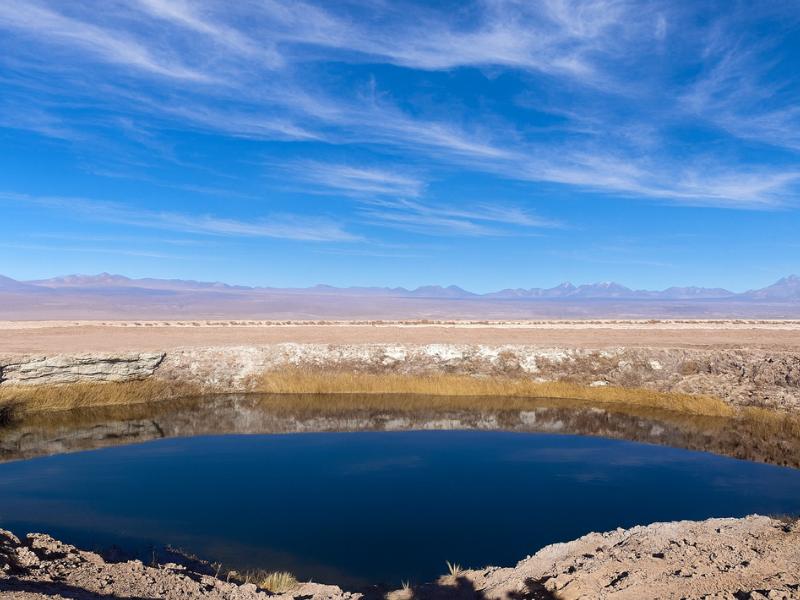
The first thirty seconds are the memorable part. Most people try to tread water out of habit, discover it is impossible to stay vertical, and end up bobbing at an angle they did not choose. Lying back is the natural position. Your chest sits higher out of the water than it does in a swimming pool, and you can hold a completely still float without moving a limb.
What nobody warns you about is the exit. Wet skin coated in brine is not pleasant, the air feels sharply cold against it, and salt begins crystallising almost immediately as the water evaporates. This is why the rinse matters, and why the sequencing of your afternoon should put the float before the rest of the trip rather than at the end.
Two firm rules from every guide on the salt flat. Do not put your head under, because brine in the eyes is genuinely painful and takes a long rinse to clear. And do not shave on the morning of the tour, since fresh razor nicks in hypersaline water are an experience people do not repeat.
Which lagoon do you actually swim in?
The Cejar system contains more than one body of water, and the pool used for bathing is not always the one on the postcard. Access arrangements are set by the local Atacameño community and have changed over the years for conservation reasons, so which lagoon is open to swimmers on your date is decided locally, not by your operator.
This causes a fair amount of confusion online, because older articles describe swimming in a lagoon that later closed to bathers, while newer ones describe a different pool in the same system. Both were accurate when written. The practical consequence for you is small: you will float in hypersaline water at the Cejar site, and the guide will take you to whichever lagoon is currently open.
What this does tell you is something useful about the whole region. Access here is community-managed rather than centrally administered, and rules genuinely change. That is also true at Baltinache, where swimming in the one open lagoon resumed in March 2025 after a period of closure. Treat any specific access claim you read, including this one, as something to confirm against a live tour listing rather than as permanent fact.
It is worth saying plainly that these restrictions exist for a reason. Sunscreen, insect repellent, body oils and sheer volume of visitors all change the chemistry of a small closed lagoon. The rules are not bureaucracy. They are the reason there is still something worth visiting.
What are the Ojos del Salar?
Two near-perfectly round pools set in flat crusted ground a short drive from Cejar, filled by groundwater rather than by the salt flat's brine. They are far less saline than the lagoons, deep, startlingly cold, and the second stop on the standard afternoon circuit.
The name means eyes of the salt flat, and seeing them from a few metres away makes the name obvious. Two dark circles sit in a pale plain with almost no transition between them, like something drilled rather than formed. They are sinkholes fed from below, which is why the water is fresh enough to swim in properly and cold enough that most people last a couple of minutes.
Because the water is not hypersaline, you sink. That reversal is part of why the circuit is built this way: you float effortlessly at one stop and then have to actually swim at the next, which makes the physics of the first stop obvious in a way no explanation manages. Whether jumping in is permitted varies, since access rules at the Ojos have tightened and relaxed over time, and depth means this is not a paddling spot.
Practically, the Ojos are a short stop of twenty to thirty minutes. The cold is the limiting factor. In winter almost nobody gets in, and the stop becomes a photo pause on the way to sunset.
| Stop | Water | What you do | Typical time | Altitude |
|---|---|---|---|---|
| Laguna Cejar system | Hypersaline, cold, turquoise against white crust | Float, rinse, walk the shoreline | 60 to 90 minutes | Around 2,300 m |
| Ojos del Salar | Fresh groundwater, deep, very cold | Swim briefly or photograph | 20 to 30 minutes | Around 2,300 m |
| Laguna Tebenquiche | Shallow, mirror-flat, heavily crusted | Sunset, drinks and snacks, photography | 60 to 90 minutes | Around 2,300 m |
The Direct Fit And Useful Alternatives
Laguna Cejar And Nearby Lagoons
Choose a lagoon outing for a change of pace from rocky valleys. This route combines Cejar with nearby Ojos del Salar and Tebenquiche.
About five hours. Bring sun protection; the itinerary and bathing access depend on current conditions.
Book on ViatorBook A Cejar Lagoon Outing ↗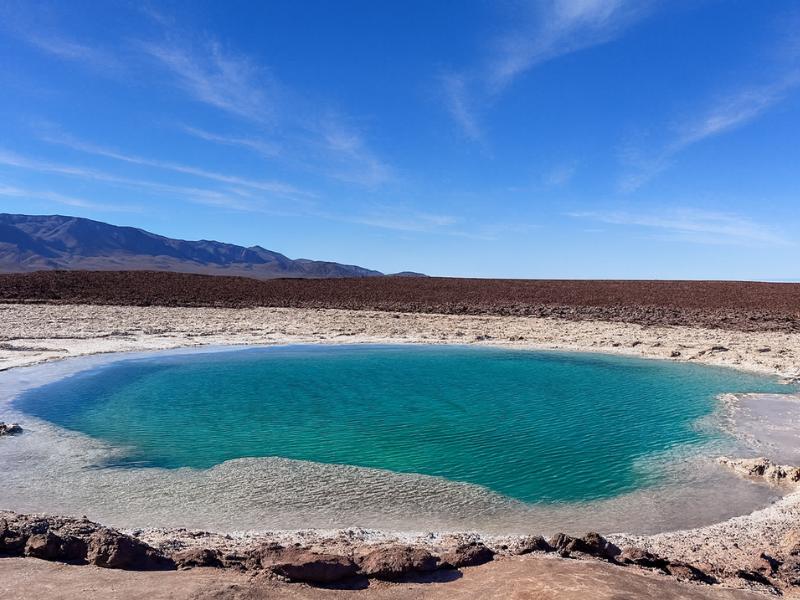
Baltinache Hidden Lagoons
Visit the chain of seven lagoons with shared transport and bilingual guiding. Choose this for the salt-and-turquoise scenery and a lagoon-focused day.
Allow about five hours. Entrance extra; urban pickup coverage and rough-road travel. Swimming depends on current access.
Book on GetYourGuideVisit The Baltinache Lagoons ↗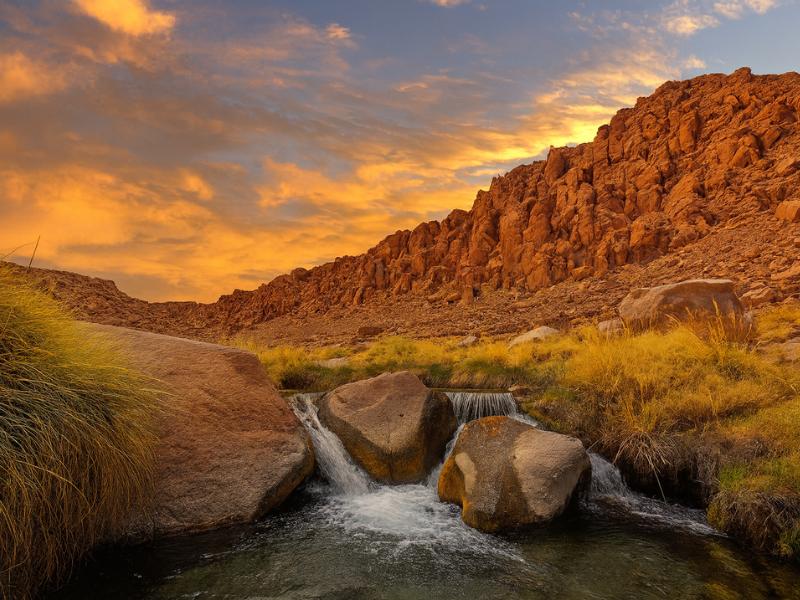
Puritama Hot Springs: AM Or PM
A hot-springs visit with transport lets you leave the driving out of your relaxation plans. Choose a morning or afternoon option.
About 4.5 hours. Bring towel and swimwear. Hotel pickup; return to central San Pedro. Confirm entrance arrangements.
Book on GetYourGuideChoose My Hot-Springs Time ↗Why is Laguna Tebenquiche the sunset stop?
Because it is broad, shallow and still. A thin sheet of water over salt crust turns into a mirror when the wind drops, reflecting the Andes and the colour of the sky across a huge surface. Operators end the circuit there, usually with a pisco sour and snacks, because it is the best light of the day.
Tebenquiche is a different kind of place from Cejar. Nobody is floating, there is no crowd of people in swimwear, and the appeal is entirely visual. The salt crust forms rough coral-like structures at the edge, sharp underfoot and unlike anything most visitors have walked on. Beyond it the water is often only ankle-deep for a long way out.
The mirror effect depends on wind, which in the Atacama tends to rise in the afternoon and fall towards dusk. Some evenings the reflection is complete and the horizon disappears. Other evenings there is enough ripple to break it. Neither is predictable in advance, and both are worth standing in.
Bring something warm for this stop specifically. You have probably been wet earlier in the afternoon, the sun is going down over a salt flat, and the temperature drop after sunset in the desert is abrupt. This is the point in the tour where people who packed a fleece look smug. The packing guide makes the same point at more length.
How cold is the water, and when is it worst?
Cold in every month, and properly cold in winter. These are shallow desert lagoons with no thermal input, so water temperature tracks the season rather than the afternoon air. In June and July many people go in to their waist, decide against it, and photograph instead.
The gap between air and water is what catches people out. A San Pedro afternoon in July can feel pleasant in the sun while the lagoon has been losing heat to clear night skies for months. Even in summer the water is refreshing rather than warm. Nobody comes here for a comfortable swim, and any listing that implies otherwise is overselling.
Timing within the day helps at the margins. Later afternoon water has had the whole day of sun on it, which makes a small but real difference in the shoulder seasons. It makes no difference at all in midwinter.
| Season | Water | How long most people stay in | Verdict |
|---|---|---|---|
| December to February | Coolest thing you will touch all day, but bearable | 10 to 20 minutes | The best window for actually floating |
| March to May | Cooling steadily | 5 to 15 minutes | Still comfortable for most |
| June to August | Cold enough to shorten the visit sharply | 2 to 10 minutes, or not at all | Go for the landscape, treat the float as optional |
| September to November | Warming again through the window | 5 to 15 minutes | Good, and less busy than high summer |
If you are travelling in winter and floating is the specific thing you came for, this is worth planning around. The best time to visit guide and the season-by-season breakdown weigh water temperature against everything else the desert does across the year, including the fact that winter delivers the best geyser plumes and the clearest skies.
Why must you rinse off, and what happens if you do not?
Because the water evaporates and the salt does not. Within minutes of leaving the lagoon you are wearing a crust that pulls at the skin, irritates anywhere shaved or scratched, stiffens fabric and will still be in your swimwear a week later. Rinsing is not optional politeness, it is basic comfort.
Facilities at the lagoons are limited and rustic. There is usually a way to rinse, sometimes little more than containers of fresh water, and it is not a shower in any sense you would recognise from a swimming pool. Guides carry water for this purpose, and one of the practical differences between operators is how well they handle the rinse. It is worth reading recent reviews on that specific point.
| What the salt does | Where it shows up | What to do |
|---|---|---|
| Crystallises on drying skin | Everywhere, within minutes | Rinse before you dress; carry a bottle of fresh water of your own |
| Stings cuts and razor nicks | Legs, face, anywhere recently shaved | Do not shave on the day of the tour |
| Burns the eyes | If you submerge or splash | Keep your head above water; rinse eyes immediately if not |
| Stiffens and marks fabric | Swimwear, towels, and any clothes you sit in afterwards | Bag wet items separately; rinse them properly at the hotel |
| Corrodes metal | Jewellery, watch straps, camera fittings | Leave valuables in the vehicle or at the hotel |
| Damages phone ports | Charging port and speakers | Dry bag, and do not take the phone into the water |
The most common regret is bringing a phone in for a floating photo. Salt water plus a charging port is a familiar and expensive story. If the shot matters, hand your phone to someone standing on dry crust.
What does the half-day itinerary look like?
Pickup in the early to mid afternoon, a short drive onto the salt flat, an hour or more at the Cejar lagoons including the float and rinse, a stop at the Ojos del Salar, then sunset at Tebenquiche with a drink and snacks before returning to San Pedro after dark. Total time is roughly five hours.
It is the easiest of the classic Atacama outings by a wide margin. There is no altitude gain to speak of, no early start, and no walking beyond the shoreline. That makes it the standard recommendation for arrival day or for the day after a punishing high-altitude trip like El Tatio.
| Time | Stage | Notes |
|---|---|---|
| Early to mid afternoon | Hotel pickup in San Pedro | Swimwear already on under your clothes |
| 25 to 35 minutes | Drive onto the Salar de Atacama | Access is via a community-managed gate |
| 60 to 90 minutes | Cejar lagoons: float, rinse, shoreline | The float itself is often shorter than people expect |
| 20 to 30 minutes | Ojos del Salar | Fresh, deep and cold; swimming is optional and seasonal |
| 60 to 90 minutes | Laguna Tebenquiche at sunset | Pisco sour and snacks on most operators; bring a warm layer |
| 30 minutes | Return to San Pedro | You arrive back after dark, in time for dinner |
Because the trip finishes after sunset, it does not combine with an evening at Valle de la Luna, which runs at the same time of day. It does combine well with a late stargazing session if you have the stamina, since the tours start after most floating trips have returned.
Choose A Date For Your Outing
Laguna Cejar And Nearby Lagoons
Select your date and party on Viator for the current price and departure options.
Book A Cejar Lagoon Outing ↗Cejar or Baltinache: which floating tour should you book?
Cejar is closer, cheaper, and pairs floating with the Ojos del Salar and a proper salt-flat sunset. Baltinache is further out on a rough road, more remote, more scenic and more strictly controlled, with seven lagoons of which only one is open to swimmers. If you have time for one, most first-timers prefer Baltinache. If you want a sunset, take Cejar.
They are genuinely different days despite doing the same thing to your buoyancy, and the choice usually comes down to whether you value the setting or the circuit. Baltinache delivers a chain of turquoise lagoons in a salt canyon with almost no infrastructure, which is why it has become the single best-selling tour on this site. Cejar delivers three distinct stops and finishes with the mirror at Tebenquiche.
| Laguna Cejar circuit | Baltinache hidden lagoons | |
|---|---|---|
| Distance from San Pedro | Around 20 km, sealed most of the way | Around 40 km, largely unpaved |
| Number of stops | Three: Cejar, Ojos del Salar, Tebenquiche | One site, seven lagoons, one open for swimming |
| Sunset included | Yes, at Tebenquiche | Depends on the departure time you choose |
| Facilities | Limited rinse facilities | Essentially none |
| Crowds | Busier; it is the closer and cheaper option | Access is capped and more controlled |
| Walking involved | Minimal | A short hike on salt crust between lagoons |
| Listed price on this site | From around $35 | From around $60 |
| Best for | A first, easy, sunset-facing afternoon | Landscape, quiet and the stronger float |
Plenty of visitors do both, and they do not feel repetitive. If you are choosing, read the full Baltinache guide before deciding, because the access rules there change what the day feels like more than the scenery does.
What should you bring to the floating lagoons?
Swimwear under your clothes, a towel, sandals you do not mind ruining, a warm layer for sunset, a bottle of fresh water purely for rinsing, sunglasses and sunscreen, and a sealed bag for everything wet. Leave jewellery, watches and anything with a charging port well away from the salt.
Footwear deserves a special mention. The salt crust at the edge of these lagoons is sharp, forming rough coral-like ridges that cut bare feet easily. Water shoes or old sandals you can wear into the shallows are the single most useful thing you can pack for this outing, and the item most people forget.
| Item | Why it matters at the lagoons |
|---|---|
| Water shoes or old sandals | The crust is sharp and cuts bare feet; salt then finds the cuts |
| Swimwear under your clothes | Changing facilities are minimal and public |
| Towel, ideally two | One gets salty and stays damp; the second is for after the rinse |
| Your own bottle of fresh water | The provided rinse is basic; a litre of your own transforms it |
| Warm layer or fleece | Sunset over a salt flat cools fast, and you have been wet |
| Sunglasses and high-factor sunscreen | White salt reflects UV upwards as well as down |
| Dry bag or sealed plastic bag | For wet swimwear and to keep salt away from electronics |
| Small cash in pesos | Community-managed access points sometimes take cash directly |
Who should skip the floating lagoons?
Anyone with open wounds or recent skin procedures, people with severe skin conditions that salt aggravates, travellers who dislike cold water enough that they will not get in, and very young children who cannot be trusted to keep their face out of the brine. Everyone else, including nervous swimmers, is fine.
The last point is worth expanding, because it inverts the usual advice. Hypersaline water is arguably the safest place a weak swimmer can be, since sinking is not physically available to you. What is dangerous is the eyes and the cold, not drowning. Families do this trip constantly, and the family travel guide covers the age question in more detail.
| If this is you | Verdict | Alternative |
|---|---|---|
| Just arrived, not yet acclimatised | Ideal first outing at around 2,300 m | None needed |
| Weak swimmer or nervous in water | Fine; floating is involuntary | Stay in the shallows and keep your head up |
| Open cuts, recent tattoo, shaved this morning | Skip the water, keep the trip | The sunset at Tebenquiche is worth the ticket alone |
| Eczema, psoriasis or sensitive skin | Cautious; salt can aggravate it | Puritama's fresh thermal water instead |
| Travelling in June or July and want to swim | Manage expectations | Go for the landscape; float only if you like cold water |
| Small children | Usually fine with close supervision | Keep faces out of the water at all times |
How does the Cejar trip fit into a three or four day Atacama plan?
It slots in anywhere, which is exactly why it is useful. No altitude, no early start and no physical demand mean it works on arrival day, on a recovery afternoon after the geysers, or as a filler when a high-altitude tour is cancelled by weather. It is the most schedule-flexible outing in the region.
A well-built three-day plan usually goes light, heavy, medium: an easy first afternoon while you acclimatise, the geysers or the altiplanic lagoons in the middle once you have two nights at 2,400 metres behind you, and something moderate to finish. The floating lagoons fit the first and third slots naturally. The classic three to four day itinerary and the how many days guide both build this out.
| Tour | Listed price | Rating | Duration | Bookings | Best for |
|---|---|---|---|---|---|
| Half-Day Laguna Cejar Experience | Around $35 | 4.8 | 5 hours | 814+ | The full three-stop circuit with sunset at Tebenquiche, small group |
| Hidden Lagoons of Baltinache | Around $60 | 4.9 | 4 hours | 6,789+ | The remote alternative, and the best-selling tour on this site |
| Multi-Day Experience with pickup | Around $540 | 4.8 | 96 hours | 1,830+ | Four days covering Cejar, the geysers, Piedras Rojas and stargazing |
Prices and availability move, so check the live listing before booking. If you are weighing whether to book ahead or on arrival, the advance versus on-arrival guide covers how far in advance each season fills up, and floating tours are among the first to sell out in January. For background on the protected areas that surround these lagoons, CONAF, Chile's national forestry corporation, administers the reserve system across the Salar de Atacama.
Make It Part Of Your Trip
This is the connected circuit for the three lagoon stops discussed in the guide.
Laguna Cejar And Nearby Lagoons
Choose a lagoon outing for a change of pace from rocky valleys. This route combines Cejar with nearby Ojos del Salar and Tebenquiche.
Book A Cejar Lagoon Outing ↗