El Tatio Geysers Guide: Sunrise, Altitude and Machuca
El Tatio sits at roughly 4,320 metres in the Andes, about 90 kilometres from San Pedro de Atacama, and the hotel pickup lands somewhere between 4am and 5am. Altitude, cold and a pre-dawn start: that combination is the entire planning problem.
Why do El Tatio tours leave at four in the morning?
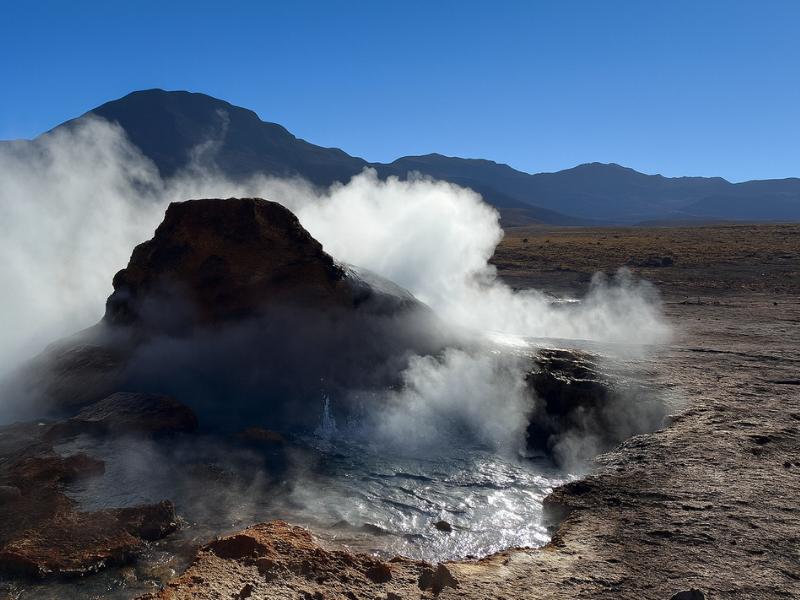
Because the geysers look their best in the coldest hour of the day. The vents are not dramatically more active at dawn, they are simply more visible: when the air sits well below freezing, escaping steam condenses instantly into tall white columns. By nine in the morning those same vents show only faint wisps.
This is the single fact that explains the whole schedule, and it is worth understanding properly before you decide whether the alarm clock is worth it. What you photograph at El Tatio is not water thrown into the air. It is condensation. Superheated water flashes to steam as it reaches the surface, and whether that steam becomes a visible plume depends almost entirely on how cold and how humid the surrounding air is. At minus eight, the plume climbs and holds. At plus twelve, the same volume of steam evaporates into invisible vapour within a metre of the ground.
Operators therefore work backwards from sunrise. The drive is roughly two hours on mostly unpaved road, the gate area needs time to fill, and guides want you standing on the boardwalks in the twenty minutes either side of first light. Pull those numbers together and pickup falls at 4am to 5am depending on the season and where your hotel sits in town.
There is a counter-argument, and honest planning means hearing it. Arriving later means warmer air, thinner crowds, and a far more pleasant experience of a place that can otherwise feel like a car park at altitude. That is exactly the trade the private El Tatio geysers experience makes: a later departure, smaller plumes, more room. Which version you want depends on whether you are here for the photograph or for the place.
Dawn Geysers Or A Private Later Visit?
Choose what you want and the time you can give it. The result explains the trade-off before you open the booking page.
What exactly is El Tatio, and how big is the field?
El Tatio is a high-altitude geothermal field spread across roughly ten square kilometres of an Andean basin, holding more than eighty active geysers alongside hundreds of fumaroles, hot springs, mud pots and sinter terraces. It is the largest geyser field in the southern hemisphere and among the three largest anywhere.
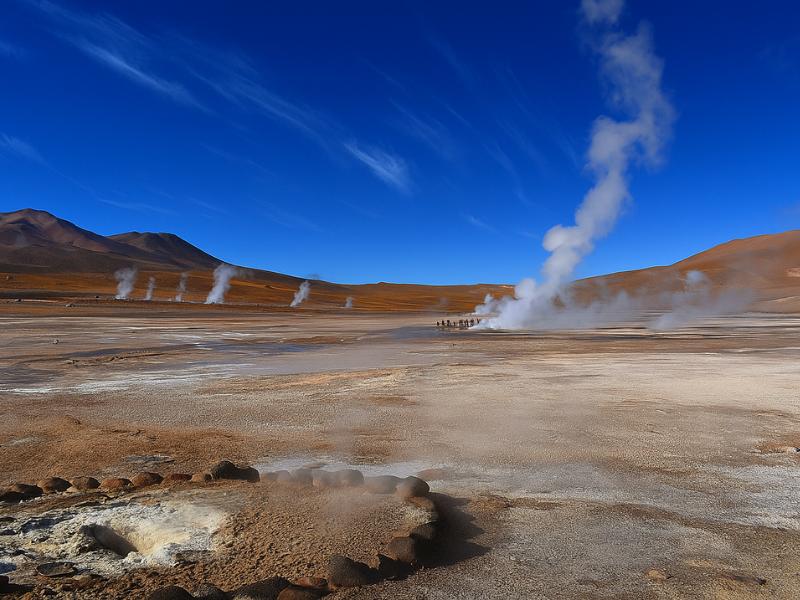
The geology is straightforward once you see the setting. Rain and snowmelt from the volcanoes ringing the basin sink through fractured rock, meet heat from a magma body far below, and rise again through a plumbing system of cracks and vents. The water that steams out of the ground in front of you fell as precipitation a long time ago and has been travelling underground ever since.
Altitude changes the physics in a way that surprises people who have been to Yellowstone. Air pressure at 4,320 metres is roughly six-tenths of sea level, so water boils at around 86 degrees Celsius rather than 100. Lower boiling point means eruptions that are broader and squatter rather than tall and violent. Most El Tatio vents push water less than a metre into the air; the biggest bursts reach a few metres. The spectacle here is one of quantity and scale across a whole basin, not of a single dramatic jet.
The field is managed by the neighbouring Atacameño communities, and there is a staffed gate with an entrance charge collected on arrival. On organised trips this is normally bundled into the tour price, but the wording varies by operator, so check the live listing rather than assuming. Walking is restricted to marked paths and boardwalks for a real reason: the crust between vents is thin, and people have been badly scalded stepping off it.
How high is El Tatio, and what does the altitude jump do to you?
El Tatio sits near 4,320 metres. San Pedro de Atacama sits near 2,400. A standard tour lifts you nearly two vertical kilometres while you are asleep in a minibus, then asks you to walk around in freezing air at dawn. That is why El Tatio produces more altitude complaints than any other Atacama day trip.
The mechanism is not mysterious. Ascent rate matters more than absolute altitude for how rough you feel, and a two-hour road climb is fast by any standard. Add three factors that all point the same way: you have slept badly, you have almost certainly not eaten, and you are exerting yourself in cold air. Headache, breathlessness on gentle slopes, nausea and a strange flat tiredness are all common, and all usually fade within an hour of descending.
The practical fix is sequencing. Give yourself at least two full nights in San Pedro before El Tatio, and put low-altitude days first. Our team's standard suggestion is to run Valle de la Luna or the salt-flat lagoons early in a trip and hold the high ground until day three. The altitude and tour-order guide sets out a full sequence, and it is the piece of planning that most changes how the week feels.
| Place | Approximate altitude | Typical time spent there | Altitude load |
|---|---|---|---|
| San Pedro de Atacama (town) | 2,400 m | Base for the whole trip | Low, but not zero for sea-level arrivals |
| Laguna Cejar and the salt-flat lagoons | Around 2,300 m | 4 to 5 hours | Negligible |
| Valle de la Luna | Around 2,500 m | 4 to 5 hours | Negligible |
| Termas de Puritama | Around 3,500 m | 2 to 3 hours in the pools | Mild, and you are resting |
| Machuca village | Around 4,000 m | 20 to 40 minutes | Moderate, but brief and on the way down |
| El Tatio geyser basin | Around 4,320 m | 1.5 to 2 hours, walking | High, and you are active in cold air |
| Miscanti and Miniques lagoons | Above 4,000 m | 1 to 2 hours | High, but later in the day |
| Cerro Toco summit | 5,604 m | Half a day of climbing | Severe, for acclimatised walkers only |
One more point that gets lost. Altitude sickness does not correlate with fitness, age or how much you want it. Marathon runners get hit and sedentary grandparents sail through. Treat it as a lottery you can improve your odds in, not a test you pass by being strong.
How cold does it actually get at sunrise?
Sub-zero is the normal case, not the exception. El Tatio commonly sits below freezing at dawn in every month of the year, and winter mornings run far colder than that. Add wind moving across an open basin and the felt temperature on the boardwalks drops further still.
People underestimate this in a specific and predictable way. They check the forecast for San Pedro, see a comfortable daytime figure, and pack for a desert. San Pedro at 2,400 metres in the afternoon and El Tatio at 4,320 metres before sunrise are different climates on different planets. The temperature swing across a single El Tatio morning is enormous: bitter at the boardwalks, mild by the time you reach Machuca, warm by the time the bus rolls back into town.
Dress for the swing rather than the average. Layers you can shed one at a time beat a single heavy coat, because you will want to be peeling back to a t-shirt within three hours. Gloves and a hat matter more than a thicker jacket, since exposed hands holding a camera lose heat fastest. Our Atacama packing guide covers the full kit list, but the El Tatio-specific version sits below.
| Stage of the morning | Rough conditions | What you actually want on |
|---|---|---|
| Pickup, 4am to 5am, in town | Cold but bearable at 2,400 m | Everything already on, so you can sleep in the van |
| Arrival at the basin, before first light | The coldest point of the day, usually below freezing | Thermal base, fleece, windproof outer, hat, gloves, buff |
| Sunrise and the first hour of walking | Still freezing, wind across open ground | Same, plus something over your ears and nose |
| Breakfast stop as the sun gains height | Climbing fast, ice melting off the boardwalks | Gloves off, hat still on |
| Thermal pool, mid-morning | Air still cold, water warm | Swimwear under your clothes, plus a towel you can reach |
| Machuca, around 4,000 m | Mild in sun, cold in shade | Down to two layers |
| Back in San Pedro, late morning | Full desert daytime heat | T-shirt, hat, sunscreen |
The Direct Fit And Useful Alternatives
El Tatio Geysers Experience
An organized geyser outing lets you make the visit the focus instead of planning the drive. Start with the departure that fits your itinerary.
An early outing. Pack warm layers and check pickup arrangements.
Book on ViatorSee El Tatio Departures ↗Private El Tatio Geysers
A private vehicle and guide for the geyser day, with breakfast and pickup in San Pedro. The itinerary is designed around a later visit than the classic dawn groups.
Arrange departure time with the provider. Entry fees extra; high altitude remains part of the trip.
Book on ViatorPlan My Private Geyser Day ↗
Puritama Hot Springs: AM Or PM
A hot-springs visit with transport lets you leave the driving out of your relaxation plans. Choose a morning or afternoon option.
About 4.5 hours. Bring towel and swimwear. Hotel pickup; return to central San Pedro. Confirm entrance arrangements.
Book on GetYourGuideChoose My Hot-Springs Time ↗What does a standard El Tatio day look like, hour by hour?
A group departure runs roughly eight hours door to door: two hours up in the dark, ninety minutes to two hours in the geyser field, breakfast on site, an optional thermal soak, then a slow descent with stops at Machuca and often a high wetland before you reach town late morning.
Knowing the shape of the day removes most of the anxiety about it. The drive up is silent and dark, and almost everyone sleeps through it. You will feel the road change surface, and you may notice your ears. Arrival is abrupt: doors open, cold hits, and there is a short walk to the boardwalks in half-light while the guide points out which vents are worth standing near.
| Time | What happens | What to do about it |
|---|---|---|
| 04:00 to 05:00 | Hotel pickup in San Pedro | Be dressed and outside; vans run tight loops |
| 05:00 to 07:00 | Climb from 2,400 m to 4,320 m | Sleep. Drink water. Do not eat heavily |
| 07:00 to 08:30 | Geyser basin at first light, guided walk | Move slowly, stay on the paths, keep the camera warm |
| 08:30 to 09:00 | Breakfast at the vehicle or shelter | Hot drinks help more than food at this altitude |
| 09:00 to 09:45 | Optional thermal pool | Decide before you undress; see the section below |
| 09:45 to 10:30 | Descent, often with a wetland stop | Vicunas, Andean geese and sometimes flamingos |
| 10:30 to 11:15 | Machuca village | Cash for the food stalls; the chapel is a short walk uphill |
| 11:15 to 13:00 | Return to San Pedro | Plan nothing demanding for the rest of the day |
Two schedule notes people wish they had known. The return time is late morning, not early morning, so an El Tatio day realistically consumes your whole day even though you are back before lunch. And the tiredness that follows is disproportionate: a 4am start plus altitude plus cold flattens most people by mid-afternoon. Booking a demanding activity for that same evening is the classic first-timer mistake.
Is the thermal pool at El Tatio worth getting undressed for?
For some people, yes. For most, no. The pool water is genuinely warm and the setting is remarkable, but you have to strip down in near-freezing air, use rudimentary changing facilities, and then get dry and dressed again at 4,320 metres. The soak is pleasant. The two minutes either side are not.
Be realistic about what is on offer. This is a natural bathing pool fed by thermal water, with basic changing huts and no comfort infrastructure. The temperature varies with where you sit and how the flow is running that morning. Some days it is a delight. Some days it is tepid at the edges and everyone is out within ten minutes.
The decision usually comes down to one question: is this your only thermal stop in the Atacama? If yes, and you have been looking forward to a soak, take it. If you have a Termas de Puritama day booked, skip the geyser pool without a second thought. Puritama is warmer, better built, far more comfortable, and lower down at around 3,500 metres, which matters when you are standing around wet.
If you do go in, the sequence that works is: swimwear on under your clothes from the moment you leave the hotel, a towel and a dry layer in a bag you can grab, shoes you can pull on over wet feet, and a plan to change fast rather than elegantly. Cold feet on a cold floor at that altitude is the part people remember.
What is the Machuca stop, and why does it come on the way back?
Machuca is a tiny Andean hamlet at around 4,000 metres on the road between El Tatio and San Pedro. A handful of adobe houses, a small whitewashed chapel with a thatched roof, llamas grazing the wetland below, and residents selling grilled llama skewers and sopaipillas. It works as a return stop because by then the sun is up and the village is awake.
The stop typically runs twenty to forty minutes, which is enough to walk up to the chapel, look down over the vega where the animals graze, and buy something hot. Bring small notes in Chilean pesos; the stalls are informal and card payment is not the norm. The skewers are the reason most people remember Machuca, and they are worth trying even at nine in the morning.
Treat it as a real inhabited place rather than a photo backdrop. Very few people live there permanently, and the daily arrival of tour vans is a large part of the local economy but also a genuine intrusion. Ask before photographing people, do not wander into yards, and take rubbish away with you. Guides will say this too, and they mean it.
Some itineraries also pause at a high wetland on the descent, where vicunas, Andean geese and occasionally flamingos feed in shallow water. It is not on every operator's route sheet, so if that matters to you, look for it in the listing rather than expecting it by default. The wildlife-heavy alternative is the Chaxa flamingo lagoon on the salt flat, which is a different trip entirely.
Who should skip El Tatio entirely?
People who have been at altitude for less than two days, anyone with a heart or lung condition who has not cleared 4,300 metres with a doctor, pregnant travellers who have been advised against high altitude, and families with very small children. Nobody should feel bad about it: El Tatio is optional, and there are better days in the Atacama for most of these groups.
The honest framing is that El Tatio is the most physically demanding of the classic Atacama day trips despite involving almost no walking. It is demanding because of altitude, cold and sleep deprivation stacked on top of each other. Take any one of those away and it is an easy morning. Combine all three and it defeats a surprising number of otherwise capable travellers.
| If this is you | Should you go? | Better option |
|---|---|---|
| Arrived in San Pedro yesterday from sea level | Not yet | Give it two more nights, or move El Tatio to the end of the trip |
| Heart, lung or blood-pressure condition | Only with medical clearance | Puritama at 3,500 m gives an Andean morning at lower load |
| Travelling with under-fives | Generally no | See the family travel guide for the lower-altitude days |
| Older traveller in good health, well acclimatised | Usually yes | Private departure removes the crowd and the earliest start |
| Prone to migraines or bad reactions to poor sleep | Think hard | The later private start costs more but changes the day |
| You have three days total in the Atacama | Yes, if you want it | But do it on day three, never day one |
| You dislike cold more than you love geysers | Probably not | Spend the morning on the floating lagoons instead |
The guide for older travellers goes into the altitude question in more depth, and the safety guide covers what to do if symptoms appear while you are up there. The short version: tell your guide early, and descending is the cure.
Group tour or private: which El Tatio trip suits you?
The shared departure is the default and the value choice: it costs a fraction of a private vehicle and delivers the classic dawn spectacle. A private trip buys a later start, warmer air, fewer people around your photographs, and a pace set by your group rather than by a schedule. Multi-day combos fold El Tatio into a wider package.
Ratings for El Tatio trips run lower than for other Atacama tours across the board, and that pattern tells you something real. It is not that operators run this route badly. It is that a cold, dark, high-altitude morning simply does not land well with everyone, and reviews reflect the experience as much as the service.
| Tour | Listed price | Rating | Duration | Bookings | Suits |
|---|---|---|---|---|---|
| El Tatio Geysers Experience | Around $62 | 4.4 | 8 hours | 1,318+ | Most travellers; the standard sunrise departure with breakfast and Machuca |
| Private El Tatio Geysers Experience | Around $425 for the private vehicle, up to six guests | Newer listing | 10 hours | 524+ | Couples and small groups who want a later, warmer, quieter version |
| 3-Day Combo with 4 Tours | Around $401 | 4.6 | 72 hours | 3,161+ | Short trips that want El Tatio, Piedras Rojas, Valle de la Luna and Baltinache handled in one booking |
Prices move, so treat these as the figures shown at the time of writing and check the live listing before you commit. If you are weighing the general question rather than this specific route, the private versus group comparison lays out where the extra spend earns its keep. For El Tatio specifically, it earns it more than on any other route, because what you are buying is a different set of conditions rather than a nicer seat.
Choose A Date For Your Outing
El Tatio Geysers Experience
Select your date and party on Viator for the current price and departure options.
See El Tatio Departures ↗When in the year is El Tatio at its best?
Winter mornings, roughly June to August, produce the biggest and whitest steam columns because the air is coldest. They are also the least comfortable mornings to stand in. January and February bring the altiplanic rains, which can close the road at short notice. The shoulder months trade a little plume height for a lot of comfort.
The seasonal pattern here is inverted compared with most destinations, because the thing you came to see performs better in worse weather. That is a genuine trade rather than a marketing line, and it is worth deciding which side of it you sit on before you book flights.
| Period | Steam columns | Comfort at dawn | Risk to the day |
|---|---|---|---|
| December to February | Smaller; warmer air condenses less | Least brutal of the year | Altiplanic storms can close the road with little notice |
| March to May | Good and improving as autumn deepens | Cold but manageable | Low; a strong all-round window |
| June to August | Best of the year, tall and dense | Hardest; well below freezing is normal | Occasional snow on the high road |
| September to November | Still strong early in the window | Improving week by week | Low; wind picks up in spring |
If your dates are fixed, this table is background rather than a decision. If they are not, the best time to visit guide weighs El Tatio against everything else the desert does across the year, and the season-by-season breakdown goes further into what changes month to month. The altiplanic rain window matters most: it is the only period when an El Tatio departure has a real chance of being cancelled outright.
What should you pack for a 4am departure at 4,320 metres?
Layers you can remove one at a time, a windproof outer shell, hat and gloves, sunglasses and high-factor sunscreen for the return leg, water, small Chilean notes for Machuca, and swimwear plus a towel only if you have decided in advance to use the thermal pool.
The kit list is short because the trip is short, but a few items do disproportionate work. A buff or scarf that covers your nose is the difference between comfortable and miserable in the first hour, because breathing freezing air is what actually makes people wretched. Sunscreen sounds absurd at dawn, but by the time you reach Machuca the UV at 4,000 metres is severe.
| Item | Why it matters here specifically |
|---|---|
| Thermal base layer | You cannot add warmth once you are on the boardwalks; nothing is for sale up there |
| Windproof outer shell | The basin is open ground and wind chill does more damage than air temperature |
| Hat and gloves | Hands holding a camera are the first thing to fail |
| Buff or scarf | Warms the air you breathe, which is the actual comfort problem |
| Sunglasses and sunscreen | UV at 4,000 m on the descent is far stronger than it feels |
| Water bottle | Dehydration worsens every altitude symptom |
| Small pesos in cash | Machuca stalls are informal; cards are not the norm |
| Swimwear and towel | Only if you have committed to the thermal pool; otherwise dead weight |
| Spare camera battery | Cold drains batteries fast, and phones shut down without warning |
How does El Tatio compare with the other big Atacama day trips?
El Tatio is the earliest, the highest and the coldest of the classic outings, and the only one where the main attraction is best in conditions you would otherwise avoid. Piedras Rojas is longer but gentler. The floating lagoons are the easiest half-day going. Valle de la Luna is the one nobody regrets.
Most visitors have three or four days and are choosing between four or five signature outings. Set side by side, the differences are more about physical demand and timing than about scenery, since all of them deliver landscapes you will not see elsewhere. The how many days guide and the classic three to four day itinerary both sequence these properly.
| Day trip | Start time | Peak altitude | Physical demand | Best placed on |
|---|---|---|---|---|
| El Tatio geysers | 04:00 to 05:00 | Around 4,320 m | High, from altitude and cold | Day three or later |
| Piedras Rojas and altiplanic lagoons | Around 07:00 | Above 4,000 m | Moderate; long day, little walking | Day two or three |
| Laguna Cejar and the floating lagoons | Mid afternoon | Around 2,300 m | Low | Any day, including arrival day |
| Baltinache hidden lagoons | Morning or afternoon | Around 2,400 m | Low; a short walk on salt crust | Any day |
| Valle de la Luna | Mid afternoon | Around 2,500 m | Low to moderate, some dune climbing | Day one or two |
| Termas de Puritama | Morning or afternoon | Around 3,500 m | Very low | The day after El Tatio |
| Cerro Toco climb | Early morning | 5,604 m | Severe | Late in a longer trip only |
One pairing our team recommends often: El Tatio one morning, Puritama the next. The geysers take something out of you and the hot springs put it back, and the two sit on the same road out of town. If you would rather not build the week yourself, the three-day combo sequences four signature outings for you, and the longer four-day multi-day experience adds stargazing and the floating lagoons on top.
What else is worth knowing before you book El Tatio?
Three things: the road can close in the altiplanic rain season, mobile coverage in the basin is unreliable, and the return time of late morning means the rest of that day is effectively spent. Plan the day after El Tatio as a soft one, and keep your booking flexible in January and February.
Cancellations happen, and they are almost always weather rather than operator decisions. If a January storm closes the high road, the trip does not run, and the sensible response is to have a second date available rather than to argue with the mountain. Booking early in your stay leaves room to rebook; booking on your last morning leaves none. The advance versus on-arrival booking guide works through how far ahead to commit in each season.
On money, budget in Chilean pesos for the small purchases and expect the tour itself to be the only significant cost of the day. The costs and budgeting guide puts El Tatio in context against the rest of an Atacama week. And if you are still deciding whether the desert as a whole earns the flights, the background reading in Britannica's entry on the Atacama Desert is a good primer on why this landscape looks the way it does.
Finally, a small piece of advice that improves the morning more than any equipment. Put the camera down for ten minutes and stand still in the middle of the field while the light comes up. Eighty vents steaming at once in near silence, with volcanoes going pink behind them, is the thing you came for, and it is very easy to spend the whole time looking at a screen instead.
Make It Part Of Your Trip
Get the classic early geyser visit without planning and driving the pre-dawn route yourself.
El Tatio Geysers Experience
An organized geyser outing lets you make the visit the focus instead of planning the drive. Start with the departure that fits your itinerary.
See El Tatio Departures ↗